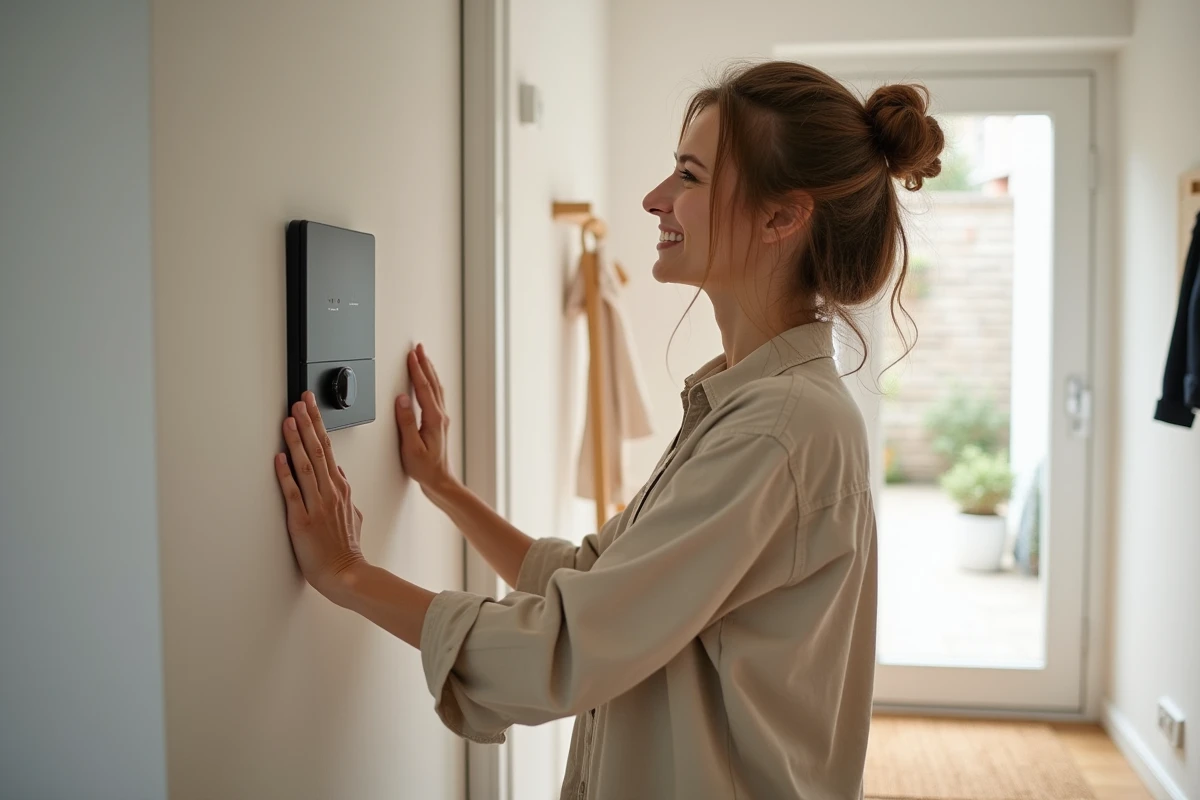
FoyerLumina is a home security solution designed for families, combining remote monitoring and connected alerts. Before committing to a subscription of this type, understanding what users really say about it helps avoid disappointments related to a product that may not fit their daily lives.
Digital mental load and notification fatigue
A recurring point in family feedback on connected security solutions is the digital mental load generated by the system. Parents describe a weariness with repeated alerts, dashboards to check, and updates to perform.
This phenomenon is not unique to FoyerLumina. Qualitative studies conducted between 2022 and 2024 by digital parenting observatories document this fatigue as a frequent reason for unsubscribing after a few months, even when the device functions correctly from a technical standpoint.
For a family with young children, a system that sends a dozen notifications a day ends up producing the opposite effect of what is sought: instead of reassuring, it generates anxiety. The ability of a tool to offer simple sensitivity settings then becomes a more determining criterion than the number of features displayed. Reading a review on foyerlumina fr by Technique Habitat helps clarify this point before committing.

FoyerLumina and family data protection
Families evaluating a connected security solution increasingly ask a direct question: where is the data captured in my home stored? Transparency regarding the location of servers and GDPR compliance has become a major trust factor.
Recent barometers on the connected home show that French households prefer providers that host their data in Europe. This preference is not solely a regulatory reflex. It reflects a concrete concern: images from home cameras or presence histories in a house constitute sensitive information.
What families check before subscribing
- The geographical location of hosting servers, with a clear preference for storage within European territory.
- The ability to delete recorded data (videos, alert logs) without going through customer service.
- The existence of a privacy policy written in a readable manner, detailing the third parties that have access to the collected information.
A security system that does not communicate clearly on these points raises distrust, regardless of its technical performance level. Digital trust conditions long-term adoption.
Integration into a home security ecosystem
A trend documented by several recent surveys on the connected home shows that families no longer want an isolated tool. They expect a solution like FoyerLumina to integrate into a comprehensive security ecosystem that includes cameras, smoke detectors, opening sensors, and possibly a voice assistant.
The problem arises when communication protocols between devices are not compatible. A smoke detector that does not communicate with the alarm panel forces users to manage two separate applications, which brings back the mental load issue mentioned earlier.
Technical compatibility: an underestimated criterion
Negative reviews about family security solutions often focus less on the reliability of the equipment than on its functional isolation. A high-performing unit that is incompatible with the devices already installed in the home ends up in a drawer.
Before choosing, checking the list of supported protocols (Wi-Fi, Zigbee, Z-Wave) and compatibility with existing connected object brands in the home avoids a costly disappointment. The value of a system is measured by its ability to work with the rest of the equipment.

Family reviews on FoyerLumina: common themes
By cross-referencing available feedback, a few trends emerge regarding families’ perceptions of FoyerLumina.
- The initial installation is generally considered accessible, even for those who are not tech-savvy.
- The default volume of alerts is perceived as too high by some users, prompting others to disable functions that are actually useful.
- The responsiveness of customer service receives mixed reviews depending on the time period, with varying response times.
- The question of value for money frequently arises: families compare the subscription cost to available alternatives on the market.
This feedback outlines the profile of a functional product, whose long-term adoption largely depends on the customization of settings after installation. A family that takes the time to adjust notification thresholds in the first week is more likely to retain the service over time.
The choice of a family security solution relies less on technological promises than on three concrete parameters: the daily demand of the system, the clarity of the data policy, and compatibility with existing equipment. On these three points, feedback on FoyerLumina shows a product that satisfies some families, provided they invest time in the initial setup.