
When looking for a short name that is readable in several languages and without tricky spelling for civil registration, Noah consistently appears on the lists. This three-syllable name has established itself in the French landscape in less than two decades, supported by a double Hebrew root and a sound that works well in French, English, and Spanish.
To understand this trajectory, one can explore in detail Noah’s meaning and popularity through its linguistic roots and birth statistics in France.
Noah and Noé: two names, one biblical root
The confusion between Noah and Noé is common when filling out the birth declaration. Both forms refer to the same character from the Old Testament, the patriarch of the ark. The difference lies in the language of arrival.
Noé is the Latinized French form, inherited from the Vulgate and the biblical text translated into Latin. Noah, on the other hand, is the direct transcription of the Hebrew Noach, taken as is in the English-speaking world. The Hebrew term Noach carries the idea of rest, comfort, and consolation.
In practice, this distinction has a concrete impact on the child’s daily life. Noah is pronounced the same way in London, New York, or Berlin. Noé, however, sometimes poses a pronunciation problem outside the French-speaking world (the final “é” is often read as “i” in English). For parents who travel or have family abroad, this detail weighs in on the choice.

Name Noah in France: a rapid rise since the 2000s
Noah was almost non-existent in French records before the late 1990s. Its emergence coincides with two parallel phenomena: the wave of short names ending in “a” (Léa, Emma, Lina for girls, then Luca, Mila, Noah for boys) and the Anglo-Saxon cultural influence on name choices.
The peak year for Noah in France is around 2008, when the name reached its maximum birth volume. Since then, it has maintained a high level. The most recent data indicates about 3,260 births registered under this name in 2024, keeping it high in the national rankings.
A name that doesn’t age quickly
The uniqueness of Noah, compared to other trendy male names, is its longevity at the top of the charts. Names like Enzo or Mathis experienced a sharp peak followed by a rapid decline. Noah, however, shows a slight upward trend in recent years (around +6% recently), indicating that the name has not yet begun its phase of decline.
Several factors explain this resilience:
- Its soft sound, without hard consonants, appeals to both Latin culture parents and those of Anglo-Saxon or Northern European origin
- Its perceived unisex character in some countries (Noa is a common female name in Israel and Spain), giving it a modern and non-gendered image
- The absence of strong social connotation: Noah is not tied to a specific background or era, unlike names strongly marked by the 1980s or 1990s
Variants and names close to Noah: how to navigate
When finalizing the choice, one often hesitates between Noah and its variations. Here are the most common forms and what distinguishes them concretely.
- Noé: classic French form, shorter by one letter, perceived as more traditional. Less readable internationally
- Noa: without the final “h”, this spelling is used as a female name in several countries (Israel, Spain, Japan). In France, it remains given to both sexes
- Noach: the original Hebrew form, very rare in France but sometimes chosen by families attached to Jewish tradition
- Noam: another close Hebrew name (meaning “sweetness”), often confused with Noah but of distinct etymology
The choice between these variants mainly depends on the priority given to international readability or anchoring in a specific linguistic tradition.
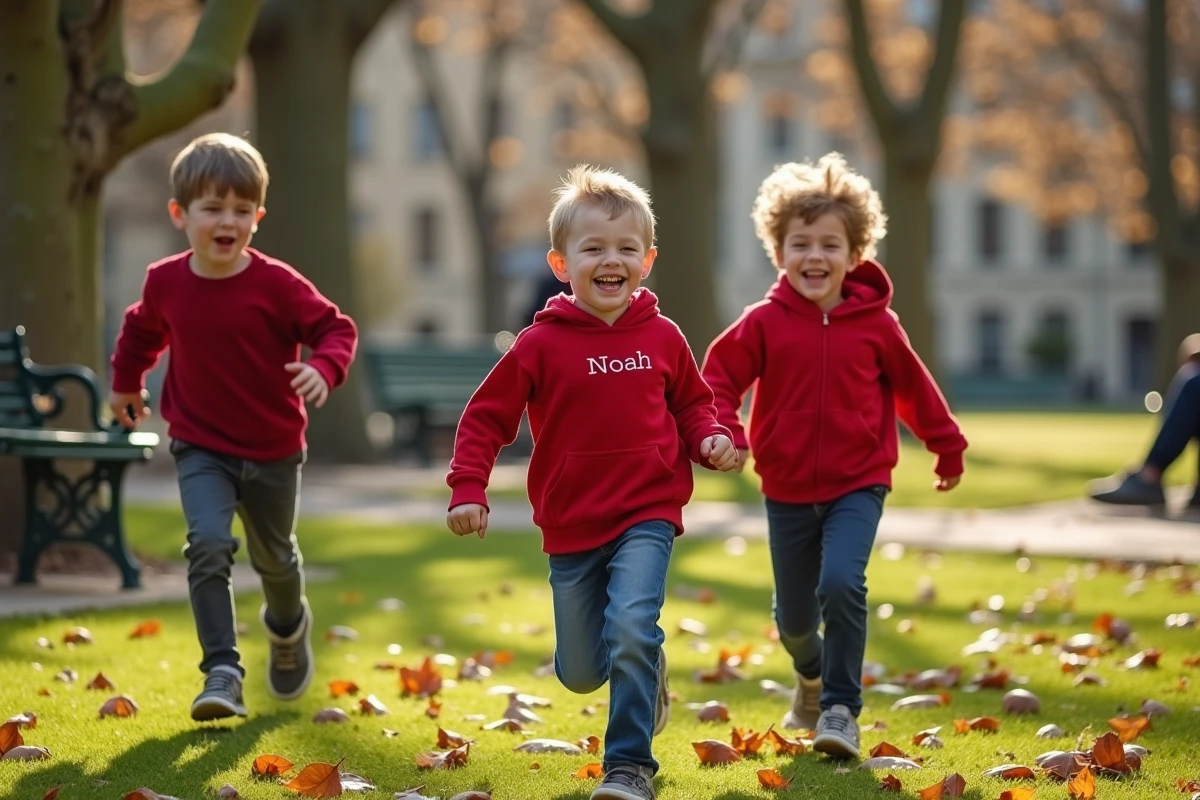
Why Noah appeals to French parents: three concrete reasons
Beyond the trend, Noah ticks practical boxes that parents quickly identify.
No imposed nickname
A two-syllable name does not get shortened. Where Alexandre becomes Alex and Maximilien becomes Max, Noah remains Noah in all contexts, from the playground to the resume. For parents who want the name to be used in full, this is a strong argument.
An easy-to-remember feast day
Saint Noah (or Saint Noé) is celebrated on November 10. This calendar reference, shared with the French form Noé, simplifies things for families wishing to mark this date.
A name that works in a bilingual family
This is probably the most underestimated factor. In mixed couples (Franco-English, Franco-German, Franco-Spanish), finding a name pronounceable by both families is a puzzle. Noah passes this filter without difficulty. The spelling is identical in the Latin alphabet, and the pronunciation varies little from one language to another.
Noah has maintained a strong presence in French maternity wards for over twenty years without showing signs of clear fatigue. Its double biblical and international root, brevity, and phonetic adaptability make it a name that meets very concrete practical criteria, far beyond a simple fashion effect.