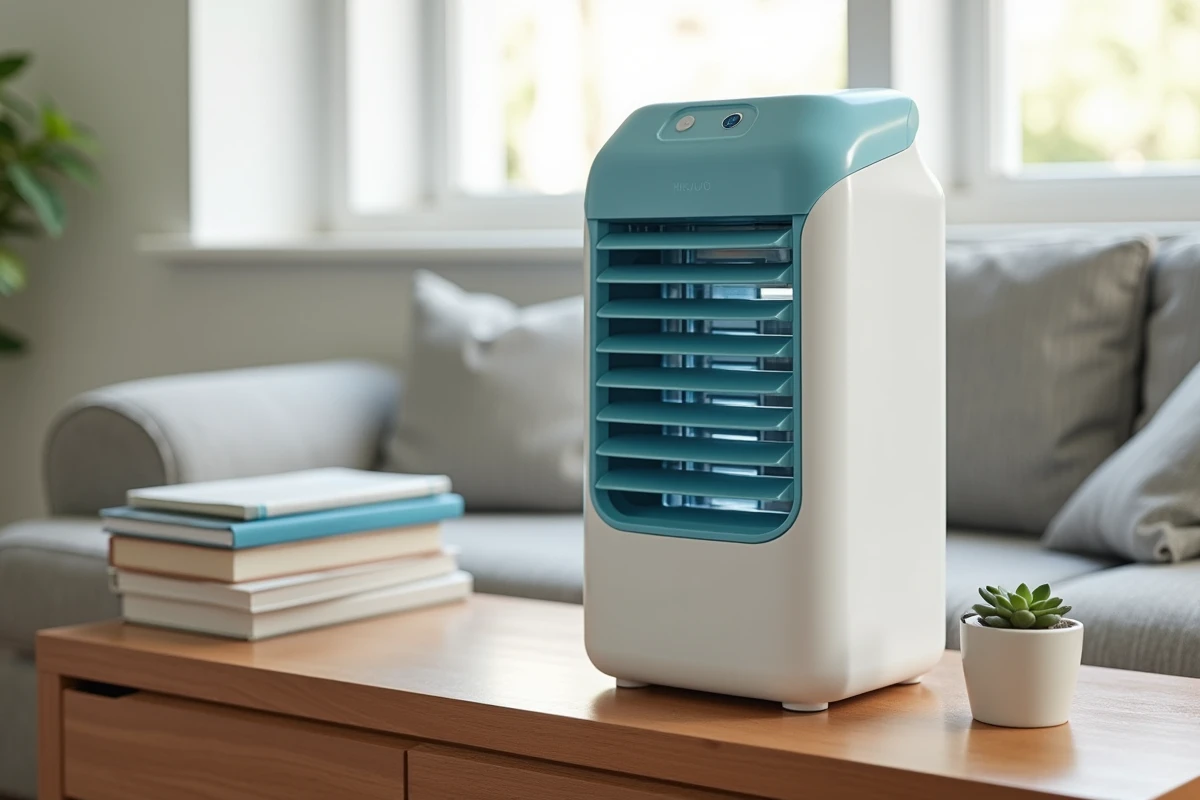
The OneConcept Caribbean Blue is one of the most affordable air coolers on the market. With a four-liter tank, an advertised airflow of 400 m³/h, and a power of 70 W, this device promises a lightweight alternative to portable air conditioners for small budgets. User feedback and recent regulatory changes invite a more critical examination of its performance beyond the simple price-to-quality ratio displayed.
Caribbean Blue in a humid urban apartment: a problematic use case
Standard tests evaluate air coolers under average conditions, rarely representative of a poorly ventilated city apartment. The Caribbean Blue operates on the principle of evaporation: warm air passes through a wet filter, and the evaporation of water lowers the perceived temperature. This mechanism relies entirely on the ambient air’s ability to absorb additional moisture.
In an urban dwelling where relative humidity regularly exceeds 70% in summer, this absorption capacity drops drastically. The device then adds humidity without cooling, which can make the atmosphere feel more stifling than before it was turned on. Feedback from users in Atlantic coastal areas confirms this phenomenon: excessive humidification makes the device counterproductive during humid heatwaves.
Since 2025, European regulations have strengthened labeling standards for evaporative coolers, requiring that their inefficiency in climates where humidity exceeds 60% be specified. The Caribbean Blue, like all models in this category, is directly affected. To learn more about the OneConcept Caribbean Blue, its detailed technical specifications allow for a better assessment of whether it fits your setup.

Airflow and actual coverage: what the Caribbean Blue is worth in an average room
The airflow of 400 m³/h seems adequate on paper for an entry-level device. In practice, the distribution of cool air also depends on the oscillation and reach of the airflow. The Caribbean Blue does not have 360° oscillation, which limits uniform coverage in larger rooms.
Recent comparative tests, including those from Stiftung Warentest published in February 2026, point to a lower performance compared to competitors with wide oscillation as soon as the area exceeds about twenty square meters. The cool air remains concentrated in a narrow corridor in front of the device.
For a small bedroom or office, this limit remains acceptable. In an open living room or a cross-ventilated studio, the experience will be significantly less convincing. The device thus finds its relevance in targeted use:
- Fixed workstation where one stays facing the device for several hours
- Bedroom of less than twenty square meters with an operable window
- Dry room (humidity below 55-60%) where evaporation produces a real cooling effect
Durability of the tank and reliability after a season of use
The removable four-liter tank is a practical asset for daily use: easy to fill, simple to clean. The lightweight plastic design facilitates handling and contributes to the device’s low footprint.
User feedback on similar OneConcept models has reported a concerning trend since 2024. Recurring leaks appear after six to twelve months of intensive use, mainly at the tank seals. This type of failure, common in entry-level devices, turns an asset (the removable tank) into a weak point by the second season.
Regular maintenance of the evaporative filter also affects the device’s longevity. A clogged filter reduces effective airflow and can promote mold growth, a risk heightened in already humid environments. The available data does not allow for a conclusion on the average lifespan of the filter, but a replacement at least once per season seems reasonable.
Electricity consumption of the OneConcept Caribbean Blue compared to air conditioners
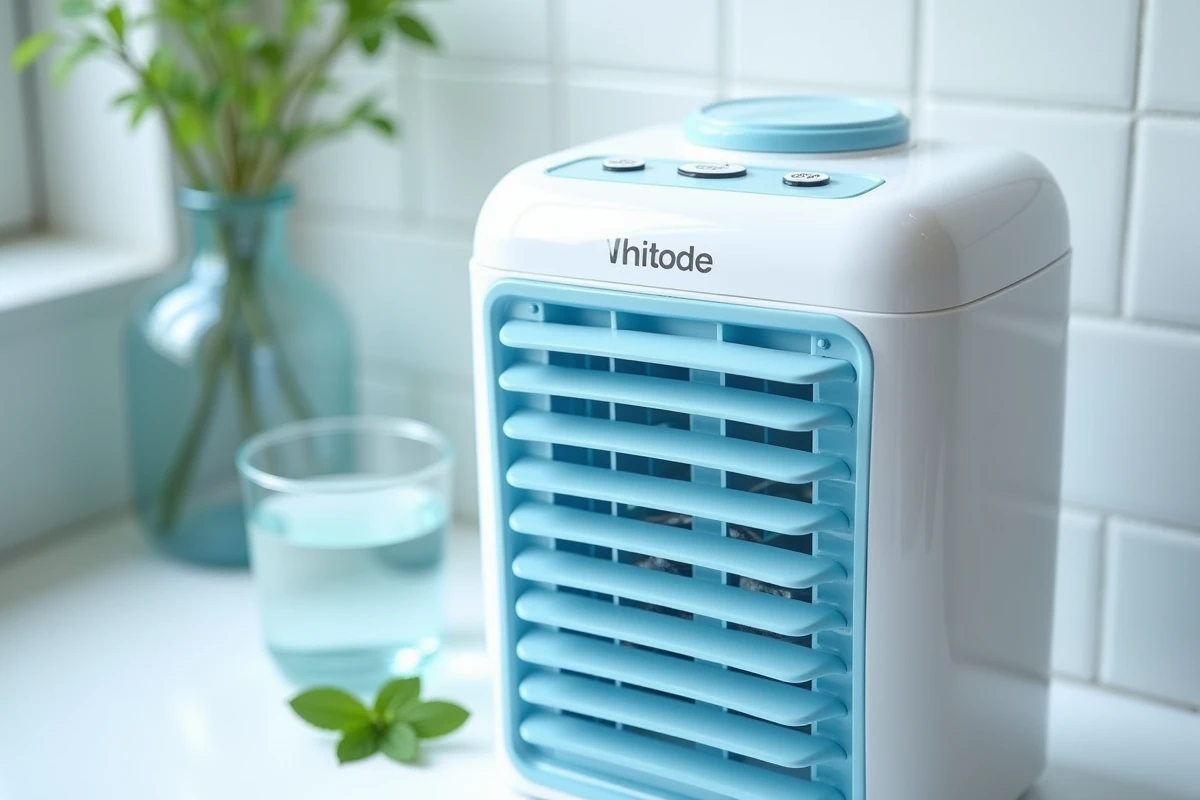
With a power of 70 W, the Caribbean Blue consumes a fraction of what a typical portable air conditioner requires. This is its strongest argument. With daily use for several hours during the hot months, the difference on the bill is significant.
This energy saving only makes sense if the device produces a noticeable effect. A cooler that runs without cooling consumes 70 W for nothing. The real question is the suitability of the product for the environment in which it is used. In a dry and well-sized room, the Caribbean Blue fulfills its role at a lower cost. In a humid and closed apartment, even low consumption is still wasteful.
Noise is the other trade-off. At maximum speed, the device becomes audible, which several users find bothersome for nighttime use. Intermediate speeds reduce noise nuisance but also airflow, and thus the already limited cooling effect.
Criteria to check before purchase
- Measure the humidity of the room with a cheap hygrometer: above 60%, the efficiency of the cooler drops significantly
- Ensure that the room size remains under twenty square meters for a perceptible airflow
- Budget for replacement of the evaporative filter and monitor the condition of the tank seals from the first season
- Compare with wide oscillation models if the room is open or L-shaped
The OneConcept Caribbean Blue remains a coherent air cooler for very targeted use: small room, dry air, tight budget. Outside of this specific framework, its limitations become flaws. The evolution of European labeling could indeed make these restrictions more visible to buyers in the coming months, which will help better guide choices.